
Moving to Spain from the U.S. | The Complete 2026 Guide | Smiths in Spain
Jul 28, 2026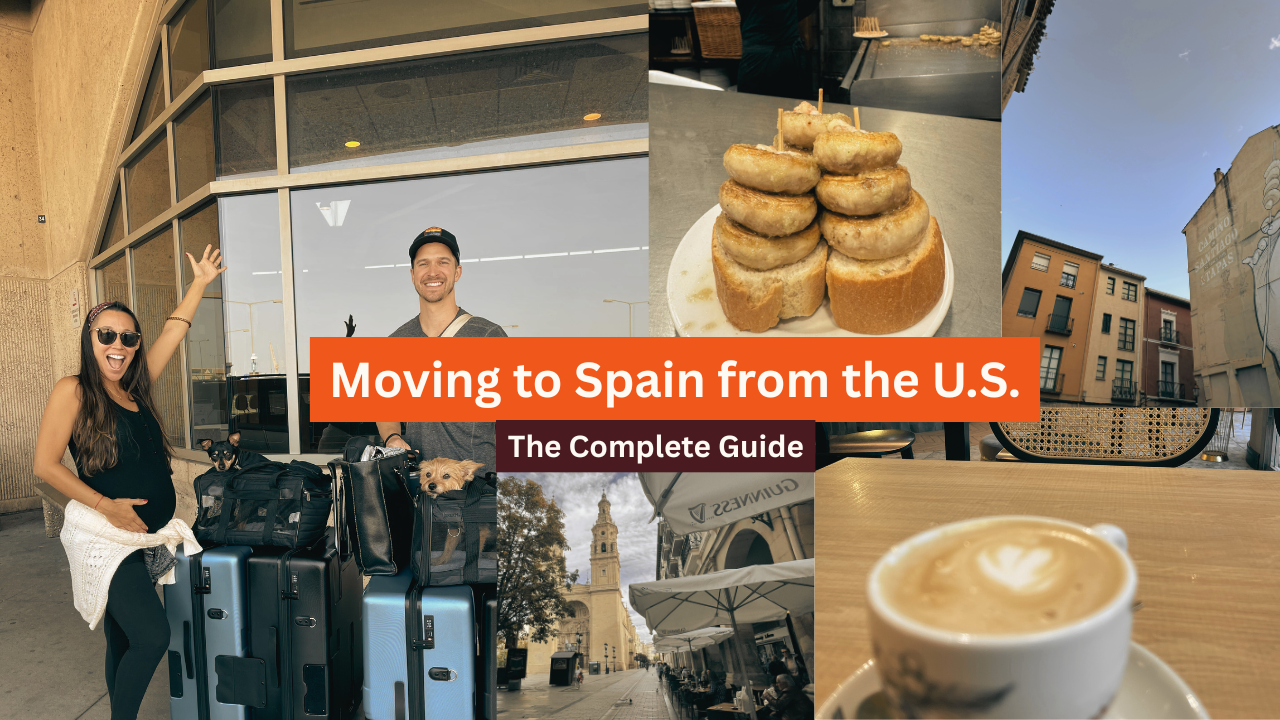
We moved our family from Lawrence, Kansas to Logroño, Spain in September 2021. I was seven months pregnant with our first. We had four suitcases, two rescue dogs, about $45,000 in savings, and absolutely no idea what we were getting into.
Five years later, it's the best decision we ever made. But I'm not going to sugarcoat it — it was also the hardest thing we've ever done. And the information we found online before we moved? Most of it was either outdated, wrong, or so generic it was useless.
So here's the guide I wish someone had written for us. Everything you actually need to know about moving to Spain from the US in 2026 — the visas, the costs, the healthcare, the culture shock, and all the stuff nobody really talks about.
Why U.S. Americans Are Moving to Spain in 2026
More U.S. Americans are seriously considering a move to Spain than ever before. And it's not just retirees — it's young families, remote workers, digital nomads, people in their 30s who looked at the cost of daycare and housing in the US and thought "there has to be another way."
Here's what's driving it. We want to be honest — after living here for over five years, the cost of living in Spain is rising and it really isn't "cheap" when you consider how locals live and how much they get paid on average. But for us as Americans? We're currently paying $915/month for a three-bedroom penthouse with a terrace in Logroño. Our grocery bill got cut in half compared to what we were paying in the U.S. — but you really can't compare, to be fair. The price of things here is relative to what people make. For us, it's worth it because of the quality of food you get, the quality of apartment, the location, and the convenience. Healthcare costs us a fraction of what we paid in the States. And don't even get me started on childcare. We stay because the healthcare and childcare can't be beat. As a family of four, that's priceless for us.
But it's not just money. It's the way people live here. We walk our kids to school. We buy bread from the bakery around the corner — and the food is actually food here, not full of a bunch of other things. What's valued in Spanish culture isn't the hustle of working 60 hours a week and saving up your vacation days so you can carry them over. It's closing things down for the entire month of August so everyone can reset, relax, and spend quality time with their family. It's enjoying all the moments throughout the day. Walking IS the activity — it's not rushing from one thing to the next all day long. The whole rhythm of life is just... different. Slower. More present. It's given us space to become our best selves and unpack this constant sense of rush that we didn't even know we had in our daily lives living in the U.S.
What Visa Do You Need?
OK, this is the part that scares everyone. Visas. Immigration. Paperwork. I get it — when we were going through it, I thought I was going to lose my mind. But once you understand your options, it starts to feel possible. Here are the main ones we see work for U.S. Americans:
Non-Lucrative Visa (NLV) — This is one that works for many. It's basically Spain saying "if you can prove you have enough money to support yourself without working in Spain, come on over." You need to show about €28,800/year in passive or savings income for a single person, plus an additional €7,200/year for each dependent. It's perfect for retirees, people living off investments or passive income, or anyone with enough savings. Important to know: the NLV does not allow you to work in Spain — not for a Spanish company, and not remotely. It's strictly a "you have the means to live here without earning income" visa.
Digital Nomad Visa — This is the newer option and it's been a game-changer for many. As of March 2026, if you work remotely for a company or clients outside of Spain and earn at least about €2,850/month (this just went up — it's tied to 200% of Spain's minimum wage), you can apply for this visa. It's designed specifically for remote workers. The tax benefits are also incredible — there's a special tax regime (called Beckham Law) that can significantly reduce your tax burden for the first several years. If you work remotely, this is probably your best bet in 2026. One thing to keep in mind: the rules around W-2 employees have been shifting. Spain tightened enforcement in 2026, and if you're employed by a US company (vs. freelance), the application process has some extra complexity. This is exactly why we always recommend people to work with an immigration lawyer.
Student Visa — This is actually what we used when we first moved. Don't let the name fool you — you don't need to be 22 to get a student visa. A lot of families use this as a "try Spain for a year" option. Enroll in a higher education program and you get legal residency for the duration of your studies. It's less paperwork than the NLV, and it gives you time to figure out if Spain is right for you before committing to a longer-term visa.
A note on the Golden Visa: If you've seen older articles mentioning Spain's Golden Visa (residency through a €500,000+ real estate investment), that program was officially abolished in April 2025 as part of Spain's housing market reforms. It's no longer an option.
No matter which visa you choose, I cannot stress this enough: get an immigration lawyer. We have an amazing immigration lawyer named Alejandro and he is in our Mr. Amigo community answering questions every week. The visa process involves a LOT of documents — criminal background checks from the FBI, financial statements, health insurance proof, marriage certificates — and many things need to be apostilled and officially translated into Spanish. Trying to navigate this alone is a recipe for delays, mistakes, and a lot of stress crying. Trust me on this one (we tried it...it stinks).
How Much Does It Actually Cost to Move to Spain?
Everyone wants the real numbers, so here you go. This is roughly what it cost us to make the move, and what I'd estimate for a family of four in 2026:
Visa + immigration lawyer + all the paperwork: €1,000-€5,000 per person. I know that's a wide range, and I'm being honest — it's not a super helpful number because it really depends on which visa you're applying for, how many dependents you have and how complicated your situation is. That range includes the lawyer's fees, government application fees, apostilles, and certified translations of all your documents. Some people on the lower end are doing a straightforward single-applicant visa. A more complex case? You're looking at the higher end. Either way, this is not the place to cut corners and will most likely be your biggest expense besides an apartment. Get the lawyer. It will save you money, time, and a lot of stress.
Health insurance (required for visa): $200-$400/month for a family of four for private coverage. You need full coverage with no copays for your visa application — that's a requirement. We work with Diana and she's incredible at finding the right plan. Our plan is just over €2,500 a year for our whole family including dental. Compared to what we were paying in the US, it still feels unreal.
Flights: $500-$1,500 per person one-way depending on when you book and from where. We flew from Kansas City. It was not a direct flight.
Shipping belongings: We didn't ship anything but we still have a storage unit back home. We pay $100 a month for our storage unit. We moved with just our four suitcases and what we could carry. If you want to ship a container, the range varies and we recommend reaching out to Laser Moving for all things shipping. They are the BEST.
Pet relocation: $1,500-$5,000 per pet for international transport. This varies a lot depending upon if your dog can go on the plane with you or not. Getting our two rescue dogs here was genuinely harder than the visa process. I'm not even joking. There's paperwork, vet visits, microchipping, airline-approved crates, and about 47 moments where we thought "are we doing this right?" It worked. But it was A LOT.
First month's costs in Spain: Budget $3,000-$5,000 for your security deposit (usually 2 months' rent), first month's rent, setting up utilities, buying basics for your apartment, and getting oriented. You'll also need a NIE number (basically your Spanish ID number for foreigners) and an empadronamiento (town hall registration). Neither of these cost much money, but they cost A LOT of patience.
All in, for a family of four, plan for $15,000-$25,000 total to make the move. We did it for less because we shipped nothing, found housing quickly, and handled some paperwork ourselves. But it's better to budget on the high end so you're not stressed.
Healthcare in Spain — What You Need to Know
Healthcare was one of our biggest worries before moving. In the US, we were paying over $800/month for a plan with a huge deductible. It was insane.
In Spain, it's a completely different world. There are two systems: public and private.
Public healthcare (Seguridad Social) — Once you're a legal resident and registered in the system, you get access to Spain's public healthcare. It's free or nearly free. but you pay taxes to access it. Our second child was born in a public Spanish hospital. The bill? Zero euros. It felt so amazing to not worry about how much our hosptial bill was going to be. I was able to be fully focused on taking care of our new baby girl. The nurses were incredible, the care was excellent, and don't get me started on the food. It was soo good. If you're coming from the US healthcare system, this will genuinely blow your mind.
Private healthcare — You'll need private insurance for your visa application (it's required — full coverage, no copays). We pay $200-$400/month for our family of four, and that includes dental. We now have access to the public healthcare system but we choose to pay for private still. Many expats (us included) keep private insurance even after getting access to the public system because it's fast, flexible, and you can see specialists without waiting. You can also telecall a doctor is you are on vacation as well, which we have done many times traveling with a baby this year. We use both depending on the situation.
And while we're talking monthly costs — our transportation is $30-$40/month. We don't have a car. We walk everywhere. Childcare for our youngest is €350 for the entire year through public daycare, and our older son is in a concertado school (semi-public). If you choose private school or private daycare, that number obviously goes up. But the public and concertado options here are great options.
The Culture Shock Is Real (But Mostly in a Good Way)
I could write an entire book on the culture shocks in Spain. Actually, I kind of already did — check out our culture shock article for the full list. But here's the highlight reel:
The schedule. Nothing in Spain happens when you think it should. Lunch is at 2pm. Dinner is at 9 or 10pm. Shops close from 2-5pm because everyone's eating and resting. When we first moved here, we were starving until 8pm when some of the restaurants would start to open!
The social life. Spain is genuinely the most social country I've ever experienced. People are OUTSIDE. Every evening, the plazas fill up with families — kids running around, grandparents on benches, friends sharing wine. There's no "scheduled playdate" culture here. You just... go outside and people are there. After the isolation of American suburban life, this felt so freakin nice.
The bureaucracy. Oh god, the bureaucracy. Spain runs on paperwork, appointments, and a system that seems specifically designed to test your patience. Getting our NIE numbers was a whole experience. Opening a bank account...Registering for our empadronamiento. You WILL want to throw something. This is normal. Take a deep breath and remember: everyone goes through this. Even Spanish people get impatient with this process.
The pace of life. Everything is slower here. And I mean everything. At first, this will annoy you — especially if you're coming from the American "optimize every minute" mindset. But give it time. Eventually, the slowness becomes the whole point. When the waiter doesn't rush you, when you realize you don't pay at the counter right away when you order a drink, when your neighbor stops to chat for 20 minutes about absolutely nothing — that's not inefficiency. That's life being lived at the speed it's supposed to be (at least in our opinion).
Finding Your Community (The Part Nobody Talks About)
Here's what I wish someone had told us before we moved: the hardest part isn't the visa, the paperwork, or the language. It's the loneliness.
When you move to a new country, you lose your entire support system overnight and you start to shed your past self immediately. And everyone's so busy posting sunset photos and saying "best decision ever!" that nobody admits how isolating it actually is.
We felt it. Hard. Especially in those first six months when the honeymoon phase wore off and we realized we hadn't had a real, deep conversation with anyone in weeks.
It gets better. But it takes intentional effort — learning Spanish, becoming a regular at a local bar, staying at the playground after school pickup, joining community groups. We've written a whole article about this because we think it's the most important topic nobody covers.
And honestly? It's the entire reason we built Mr. Amigo. After hearing hundreds of people in our DMs say "I want to do this but I don't know anyone" and "I just moved and I feel so alone," we realized we could connect all of these people together. People dreaming about Spain, people planning their move, people who just arrived, people who've been here for years — all-in-one community where nobody has to figure this out alone no matter what part of the journey they are on.
If we'd had something like Mr. Amigo when we moved, our entire first year would have been different. We wouldn't have spent months in isolation, guessing about visas, panicking about whether we'd made a huge mistake. We would have had people to ask questions to and we would have felt seen and less freakin alone.
Is Moving to Spain Right for You?
I'm not going to tell you it's right for everyone. It's not. Here's how I'd think about it:
Moving to Spain might be right for you if: you're craving a slower pace of life, you want more time with your family and less time commuting, you value community and social connection, you're open to learning a new language (even imperfectly), you can work remotely or have passive income, and you're willing to be uncomfortable for a while in exchange for something extraordinary.
Moving to Spain might NOT be right for you if: you need to earn a high US salary from a US-based employer who requires you to be physically in the States, you're not willing to deal with significant paperwork and bureaucracy, you need to be near your extended family consistently, or you expect everything to work exactly like it does in America (it won't, and that's kind of the point).
The people who thrive here are the ones who embrace the chaos. Who laugh when the appointment system doesn't make sense. Who say "yes" when their neighbor invites them for a glass of wine at 10pm on a Tuesday (at least at the beginning). Who understand that the dream of living in Spain is real — but it comes with hard days too. Both things are true.
We've been here since 2021. We have two kids who are growing up bilingual, running around Spanish plazas, eating jamón like it's a basic food group. We have friends from all over the world. We have a community of people who share this dream — some who are still planning, some who just arrived, some who've been here longer than us.
And every single day, even the hard ones, we look at each other often and say: "Can you believe this is our lives?"
If that's the life you want, you can have it. And you don't have to figure it out alone. We got you!
- Jess & Eric Smith
Frequently Asked Questions About Moving to Spain from the U.S.
Can a U.S. citizen move to Spain?
Yes. U.S. Americans can move to Spain, but you need a visa to stay longer than 90 days. The three routes that work for most people are the Non-Lucrative Visa if you have passive income or savings, the Digital Nomad Visa if you work remotely for companies outside Spain, and the Student Visa if you enroll in a program. Which one fits comes down to where your money comes from.
How much money do you need to move to Spain from the U.S.?
For a family of four, budget $15,000–$25,000 for the move itself. On top of that, your visa has its own income requirement: roughly €28,800/year for a single applicant on the Non-Lucrative Visa, plus €7,200 per dependent, or about €2,850/month for the Digital Nomad Visa. We moved with about $45,000 in savings.
Is it cheaper to live in Spain than the U.S.?
For most U.S. Americans, yes. We pay $915/month for a three-bedroom penthouse with a terrace, $30–$40/month for transportation because we do not own a car, and €350 for an entire year of public daycare. Health insurance for our family of four is just over €2,500 a year including dental. That said, salaries here are much lower than in the U.S., so it is only cheap relative to an American income.
Do you need to speak Spanish to move to Spain?
You can arrive without it, and plenty of people do. But it decides what kind of life you have here. Without Spanish you stay inside the international bubble. With even bad Spanish, spoken badly in public, you start belonging to your town instead of just living in it.
Do you need an immigration lawyer to move to Spain?
You are not legally required to have one, but we recommend it without hesitation. The process involves FBI background checks, financial statements, proof of health insurance and marriage certificates, many of which need to be apostilled and officially translated into Spanish. We tried doing parts of it ourselves and it was not worth the stress.
Does Spain still have a Golden Visa?
No. Spain officially abolished the Golden Visa in April 2025 as part of its housing market reforms. If you see an article still recommending residency through a €500,000 property investment, it is out of date.
What is the hardest part of moving to Spain?
Not the visa, and not the paperwork. It is the loneliness. You lose your entire support system overnight, and the honeymoon phase wears off around month six. It gets better, but it takes intentional effort: learning Spanish, becoming a regular somewhere, staying at the playground after school pickup, and finding people before you need them.
Keep Reading
- What Daily Life in Spain Is Really Like (Our Honest Take)
- How to Find Your People in Spain: An Expat's Guide to Real Community
- Take the quiz: find your amigos in Spain
$14.99/month — Cancel anytime
Come find your Amigos.
You don't have to wait until you get here to start building your life in Spain. Answer three quick questions and we'll show you the Amigos, experts and locals ready to help. 🧡