What Daily Life in Spain Is Really Like (U.S. American Family's Honest Take)
Jul 28, 2026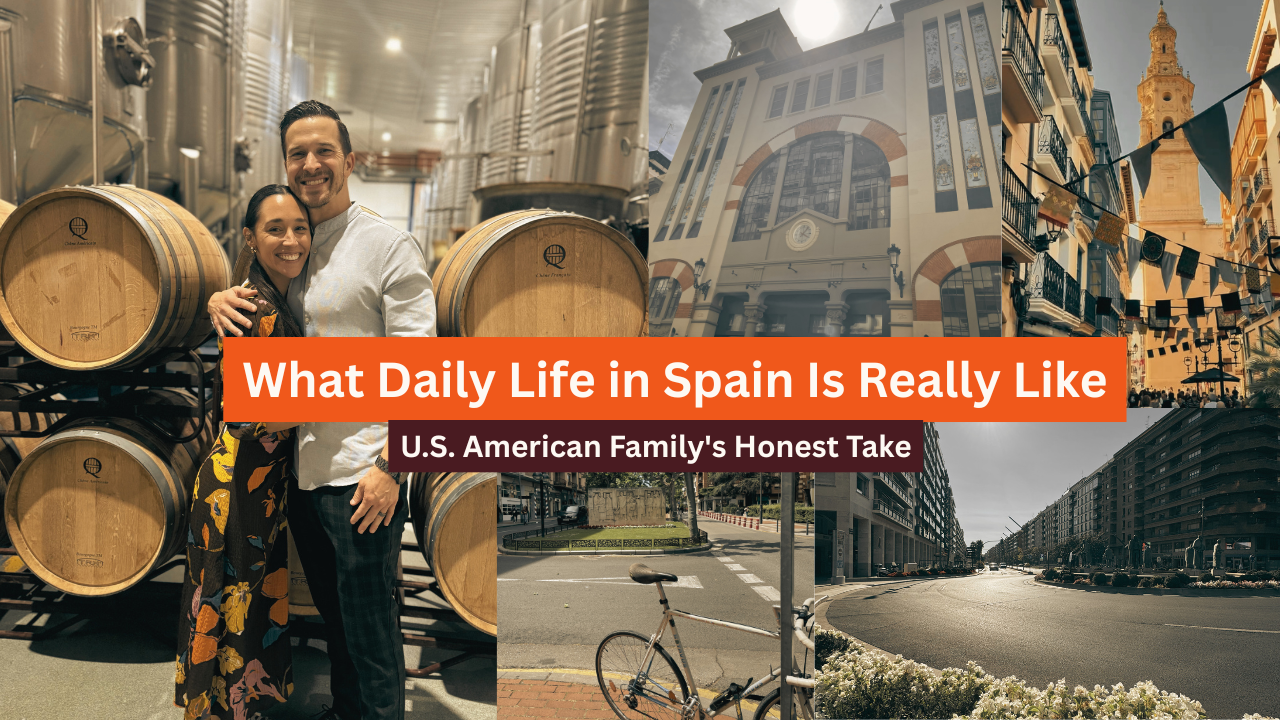
Our kids walk to school. We buy bread from the bakery around the corner almost every morning. Most evenings, the whole neighborhood is outside and the kids are running around the plaza, adults at cafés with wine, with just a vibe you have to feel for yourself.
This is a normal Tuesday for us in Spain.
People always ask us what daily life in Spain is actually like — not the vacation version, not the Instagram highlight reel, but the regular, boring, Tuesday-afternoon version.
So here it is.
The honest, unfiltered reality of what it's like to live in Spain as a U.S. American family, five years in.
A Typical Day in Our Spanish City
We live in Logroño, a city in the La Rioja region of northern Spain. It's not Barcelona or Madrid. It's a mid-size Spanish city, and it's the perfect size for us.
Our mornings start slower than they ever did in Kansas. Nobody's rushing to beat traffic because, well, most days we're walking.
The kiddos get ready for school/daycare and we walk them there. It's about an 8-minute walk to our son's school and our daughter's daycare. On the way, we are present and having conversations with our little beans.
We often stop to get a coffee after we drop them off and just start the morning together on a terraza.
After school/daycare drop-off, our workday starts. We both work remotely, so our mornings are meetings, emails, and some content creation depending on the day.
The big difference for us is that when we lived in the U.S., we both worked completely different jobs. I owned a pet-sitting business and my husband was a sous chef, and we never saw each other. We worked all the time. There wasn't enough time to sleep, let alone time to be present.
We now work from about 9am–2pm and then get ready to pick up the kiddos.
Lunch is where things get really different.
In Spain, lunch is typically the main meal of the day and restaurants generally serve it later than we were used to in the U.S. Here in Logroño, things really do slow down in the middle of the day. Some smaller businesses close, people head home or go out for lunch, and the rhythm of the city changes.
When we first moved here, this drove us crazy.
We were used to grabbing something at our desk at noon and powering through.
Now?
Lunch is sacred.
We sit down. We eat real food. We take a break. We tomamos el sol — go out on our terrace and soak up the sunshine — and it turns out the Spanish have been doing this right the whole time!
Our favorite time of day is LUNCH time!
Afternoons are a mix of work, errands, and kid stuff after the lunch break, which usually ends around 4pm at our house.
The kids play outside in the park or go to an after-school activity like swimming or football.
During the week, we enjoy a low-stress social scene that doesn't take that much planning, and we prefer it this way. Many families living in Spain do things completely differently, but we intentionally only plan about two activities a week for our oldest.
We want to leave plenty of time for him to just be bored and be a kid.
Dinner is late for us, usually around 8pm, and we're definitely aware that many Spanish families eat WAY later than we do.
But this is what works for our family. It's our way of balancing the Spanish culture we're living in with the culture we came from, where eating dinner at 6pm felt completely normal.
We like to have both kids asleep by 9–9:30pm.
This was one of the biggest adjustments for us, and honestly, the kids still eat earlier because... they're kids.
But living on a later schedule means our evenings feel long and relaxed. There's time for walking around, sitting on a terrace, hanging out in the plaza, and just existing without a schedule for a few hours.
The Walkability That Changes Everything
I cannot overstate how much walkability changes your quality of life.
And I don't mean "walkable" the way American cities sometimes use that word, where it means there's a sidewalk next to a six-lane road and a strip mall.
I mean actually walkable.
We walk to school, the grocery store, restaurants, the doctor, the park, and our friends' houses.
Our car sits in the garage most days.
In Kansas, we drove everywhere. Every single thing required getting in the car.
Here, we walk.
And something about that changes the way you experience a day.
You notice things. You run into people. You feel like part of your neighborhood instead of just passing through it in a car with the windows up.
And it's not just Logroño. Many Spanish cities and towns are compact and walkable, with everyday things much closer together than what we were used to in the U.S.
It's one of those things you don't realize you were missing until you have it.
Food, Markets, and the Spanish Schedule
The food situation in Spain is something I could talk about forever.
The short version: we eat better here and spend less on groceries than we did in Kansas.
We shop at a mix of the local market, Mercadona, and the bakery around the corner.
Fresh bread from our neighborhood bakery is usually around €1, depending on what we're buying. Olive oil is everywhere and it's incredible. Fruit actually tastes like fruit.
The market culture is one of my favorite things about Spain.
Here in Logroño, we have Mercado de San Blas, our traditional central market, with individual stalls selling meat, fish, cheese, produce, and more.
And that's what I love about markets like this.
They're not just a cute farmers market you visit on Saturday morning. They're part of everyday life. You start recognizing the vendors. They know what you like. They'll tell you what's good that day.
Eating out is also completely different here.
One of our favorite things is a menú del día — a set lunch menu offered by many restaurants, usually with multiple courses and often including things like bread, dessert, and a drink depending on the restaurant.
For us, going out for lunch or dinner regularly is much more realistic here than it ever was in the U.S.
Sunday lunch at our favorite restaurant is one of our family traditions now.
The one food thing that takes adjusting: the schedule.
Meals generally happen later in Spain than they do in the U.S. Lunch is later, dinner is later, and merienda — a snack in the late afternoon — is very much a thing, especially for kids.
It took us a good six months to stop feeling hungry at all the wrong times.
The Social Life You Didn't Expect
The social culture we experience in Spain feels fundamentally different from what we were used to in the U.S., and it took us a while to understand it.
In the U.S., socializing for us was something you scheduled.
You text your friend. You pick a date two weeks from now. You meet at a restaurant.
Here, so much of our social life just... happens.
You run into people because you walk everywhere. You see the same parents at the playground. Your neighbor asks if you want a coffee because you're both outside at the same time. You see the same people at your regular café.
It's less planned and more organic.
And at first, that felt hard because we didn't have any of those organic connections yet.
Everything was new and we didn't have the network.
But once you start becoming a regular — at the café, at the playground, at the bakery — the connections start building naturally.
It just takes longer than you want it to.
The other thing we've noticed is how much social life here revolves around food and being outside.
People eat together, drink together, sit outside together.
So much happens out in the world — at restaurants, on terrazas, in plazas.
Once we started leaning into that, our social life in Spain began to feel really full in a way that was completely different from what we knew before.
The Hard Parts Nobody Posts About
OK, so I've been painting a pretty beautiful picture, and I need to balance it because it's not all terrace wine and bakery bread.
Bureaucracy will test your sanity.
Every administrative task seems to take three times longer than you think it will.
Getting your NIE. Registering at city hall. Opening a bank account. Figuring out which appointment you need and which piece of paperwork you didn't know existed.
Five years in and Spanish bureaucracy still surprises us.
You just get better at laughing about it.
You will miss convenience.
Some smaller stores close in the middle of the day. Sunday opening depends heavily on the type of store, location, and time of year. Things don't always operate on the schedule we were used to in the U.S.
And honestly, we've also changed the way we shop.
We go to the bakery for bread, the market for certain foods, the pharmacy for medicine.
It's charming when you have time and incredibly annoying when you're in a rush.
A lot of daily life here just moves at a different rhythm.
The language barrier is real and humbling.
Even after five years, there are still moments where we feel like we're not quite getting it.
The early months were especially hard — not being able to explain what you need at the pharmacy, not understanding the school newsletter, feeling like a child in adult situations.
It gets better.
But "better" doesn't mean "gone."
You will miss people.
This is the one that doesn't go away.
We miss our families. We miss our friends. We miss the ease of being in a place where everyone speaks your language and gets your cultural references.
FaceTime helps, but it's not the same.
This is the real cost of living abroad that nobody puts in their budget.
Our first year was one of the hardest years of our lives.
I need to say that clearly because it's really easy to sugarcoat moving abroad.
After our first year, we seriously questioned everything.
The excitement had faded, the hard stuff was piling up, and we had to decide if we were going to keep going or go home.
We stayed.
And it got so much better.
But that first year?
It's a lot.
Would We Ever Go Back?
People ask us this constantly.
The honest answer: no.
Not right now. Maybe not ever.
And it's not because Spain is perfect — it's not.
The bureaucracy can be insane. Missing family is hard. Some days are just regular, difficult days regardless of what country you're in.
But the rhythm of life here has changed us in a way that would be really hard to undo.
The walkability.
The food.
The fact that our kids play outside every day.
The pace that gives us more time to actually be present.
The neighbors who know your name.
The long lunches on a random Wednesday.
The feeling of walking through the plaza at sunset and thinking:
"This is just a normal day for us."
We didn't just move to Spain.
We changed how we live.
And going back to the way we lived before — the commuting, the drive-throughs, the "I haven't seen my friends in three months" — feels impossible now.
If you're curious about this life — if something about reading this made you feel something — it might be worth paying attention to that feeling.
We had that feeling sitting in Kansas.
And we're really glad we listened to it.
And if you're figuring out how to make Spain home too, Mr. Amigo is here to make your move way easier... and a whole lot more fun.
It's our move to Spain community + app that brings all the right people with the right answers together in one place — trusted experts, expats, and Spanish locals.
Because you don't have to wait until you land in Spain to start building your life here.
Daily Life in Spain: Quick Answers
What is daily life like in Spain for U.S. Americans?
For us, it's slower, more walkable, and far more social than the life we had in the U.S.
Our days are built around walking, a real lunch break, spending time outside, and seeing people naturally as we move through our neighborhood.
But Spain isn't one single lifestyle. Living in Madrid, a tiny pueblo, a coastal town, or Logroño can look completely different.
What time do people eat lunch and dinner in Spain?
Meals generally happen later than they do in the U.S.
Restaurants commonly serve lunch from early afternoon into the late afternoon and dinner from around 8pm onward. In our family, we usually eat lunch around 2pm and dinner around 8pm — earlier than many Spanish families.
And yes, merienda around 5–6pm is very much a thing in our house.
Do you need a car to live in Spain?
It completely depends on where you live.
In a compact city like Logroño, we can walk to school, the market, the doctor, the park, restaurants, and our friends' houses, so our car stays in the garage most days.
If you live somewhere rural or outside a city center, your experience can be very different.
Is Spain a good place to raise kids as a U.S. American family?
For us, absolutely yes.
Our kids walk to school, spend tons of time outside, and are growing up surrounded by another language and culture.
Our youngest's public daycare costs our family around €350 for the entire school year, although childcare fees and subsidies vary depending on the program and family situation.
The independence and everyday outdoor life our kids experience here is one of the biggest quality-of-life differences for us.
What is the hardest part of living in Spain?
For us, bureaucracy and missing people back home.
The first year was especially difficult because once the excitement of moving wore off, we were still trying to build friendships, understand the language, navigate paperwork, and figure out how everyday life worked.
It got dramatically better.
But building a life somewhere new takes time.
Keep Reading
Moving to Spain from the U.S.: The Complete 2026 Guide
Visas, real costs, healthcare, and all of it.
How to Find Your People in Spain
The loneliness nobody warns you about — and the things that actually helped us.
Giving Birth in Spain Was So Wonderful
Spanish healthcare from the inside.
Come find your Amigos.
You don't have to wait until you get here to start building your life in Spain. Answer three quick questions and we'll show you the Amigos, experts and locals ready to help. 🧡